Temple
Jerusalem's Mysterious Well of Souls May Hold Ancient Secrets
By Mati Milstein
The answer to one of the world's most stubborn mysteries may lie hidden on the site of the destroyed Jewish Temple—under a historic Islamic shrine, beneath a bedrock outcropping of utmost significance to the three major monotheistic religions, and in a secret chamber below an underground cave.
The Well of Souls, thought to be located on the Jerusalem site known to Jews as the Temple Mount and to Muslims as the Noble Sanctuary, may contain the fabled and elusive Ark of the Covenant. This is the sacred vessel that, according to biblical account, contained the original Ten Commandments tablets that God gave to Moses at Mount Sinai as the ancient Israelites wandered the desert.
In Raiders of the Lost Ark, the intrepid Indiana Jones finds the Ark of the Covenant in a room called the Well of Souls, though in the Hollywood version the site was relocated from Jerusalem to the ancient Egyptian city of Tani.
The Well of Souls is purportedly located below a natural cave under the rock upon which Jewish tradition says Abraham prepared to sacrifice his son Isaac. Islamic tradition indicates Muhammad ascended to heaven from this same stone.
No one knows with absolute certainty whether the Well of Souls—or the Ark of the Covenant—actually exists. Though knocking on the floor of the cave under the Muslim Dome of the Rock shrine elicits a resounding hollow echo, no one has ever seen this alleged chamber.
The Temple Mount itself is rife with a network of some 45 cisterns, chambers, tunnels, and caves.
No Archaeological Evidence
There has never been any proper archaeological exploration of the site, which is under control of the Waqf Muslim religious trust.
Famed 19th-century British explorers Charles Wilson and Sir Charles Warren could neither prove nor disprove the existence of a hollow chamber below the cave. They believed the sound reportedly heard by visitors was simply an echo in a small fissure beneath the floor.
Shimon Gibson, senior fellow at the W. F. Albright Institute of Archaeological Research in Jerusalem, published a definitive review together with colleague David Jacobson called Below the Temple Mount in Jerusalem: A Sourcebook on the Cisterns, Subterranean Chambers and Conduits of the Haram Al-Sharif.
"Since the 19th century, no Westerner has been allowed access to the subterranean chambers on the Temple Mount," Gibson said. "I would have liked to disguise myself as a local Waqf worker and infiltrate these sites, but I wouldn't want to run the risk of creating an international incident."
Historic references to the Ark of the Covenant were rare following the establishment of the First Temple, and it disappeared entirely from the record by the time of King Herod around 40 B.C.
The Ark was possibly demolished during the Babylonian destruction of the First Temple in 586 B.C. or was spirited away and hidden during the invasion. It might also have been destroyed or stolen when the Roman legions invaded Jerusalem in A.D. 70.
Unlikely Survivor
According to biblical accounts, the Ark was constructed of wood and coated with sheets of gold. There is general scholarly agreement that, at least at one point, it was indeed hidden in a chamber under the Temple Mount, perhaps in the Well of Souls. However, it would not likely have survived the damp and unfavorable conditions.
"The Ark probably would have disintegrated. Unless, of course, it had holy properties. But I, as an archaeologist, cannot talk about the theoretical holy properties of a wooden box," Gibson said.
The mystery of the Ark of the Covenant has fascinated laymen, writers, and armchair explorers for centuries.
"Countless books have been written on this. Indiana Jones is simply another one, though in movie format," Haifa University archaeologist Ronny Reich said. "But we have no real information on this."
The Temple Mount and the natural cave below the Dome of the Rock are periodically open to tourists, depending upon the local security and political situation.
Source: National Geographic
Friday, June 20, 2008

What's Inside Rome's Ancient Catacombs?
Tomb
What's Inside Rome's Ancient Catacombs?
By Maria Cristina Valsecchi
A cross inlaid in the floor of a library marks the spot where Indiana Jones has to dig to access the ancient catacombs of Venice in the film Indiana Jones and the Last Crusade. The catacombs, a network of dark and narrow underground tunnels and tombs, hold the secret that eventually leads Indy to the hideout of the Holy Grail
Unfortunately, the dramatic scene is a narrative license. "There are no catacombs in Venice, as the town rises on wood piles in the middle of the saltwater Venetian Lagoon. There is no room for underground chambers or passages, and only a few buildings have a basement," says Luigi Fozzati, head of the Archaeological Superintendence of Veneto.
In fact, Venice's cemetery is located on a small island outside the town, and the oldest tombs of nobles and heads of state lie aboveground in churches.
Rome, Capital of Catacombs
To find catacombs, go to Rome, home of some of the oldest and longest burial underground tunnels in the world. "Hundreds of kilometers of catacombs run underneath the town and its outskirts," says Adriano Morabito, president of the association Roma Sotterranea (Underground Rome). "Some of the networks are well known and open to visitors, while others are still scarcely explored. Probably there are a number of lost catacombs, too."
The oldest tunnels date back to the first century. "The Jewish community in Rome built them as cemeteries. Christian catacombs came a century later. They were not secret meeting places to survive persecutions, as historians thought in the past, but burial tunnels, like the Jewish ones," Morabito explains. "They used to grow larger and larger around the tombs of saints because people asked to be buried near their religious leaders."
All Christian catacombs in Rome are property of the Catholic Church, and no one is allowed to explore them without special permission from the Vatican. "It's not so easy to get the permission. That's one of the reasons there have been very few archaeological expeditions to less known tunnels in the last decades," Morabito says.
The Legend of the Holy Grail
The aura of mystery surrounding the catacombs has fed legends for centuries. Recently, Alfredo Barbagallo, an amateur archaeologist, claimed that the Holy Grail could be hidden in Rome, in the catacomb underneath the Basilica of San Lorenzo Fuori le Mura, near the tomb of St. Lawrence, a deacon martyred in A.D. 258.
According to a legend, Pope Sixtus II entrusted the Holy Grail to Lawrence to save it from the persecution of Emperor Valerian. The deacon put the chalice in a safe place—and perhaps even sent it to Spain—before being killed. Barbagallo thinks the Grail never left Rome and is currently buried in a tunnel under the basilica dedicated to St. Lawrence.
Vatican authorities denied permission to open the catacomb and look for the chalice. "There isn't any solid evidence behind Barbagallo's claims," says Vincenzo Fiocchi Nicolai, rector of the Pontifical Institute of Christian Archaeology.
Adriano Morabito agrees. "We don't expect any great discovery from Roman catacombs. Early Christians didn't use to bury objects with the dead. As for now we only found inscriptions and human remains
Source: National Geographic
What's Inside Rome's Ancient Catacombs?
By Maria Cristina Valsecchi
A cross inlaid in the floor of a library marks the spot where Indiana Jones has to dig to access the ancient catacombs of Venice in the film Indiana Jones and the Last Crusade. The catacombs, a network of dark and narrow underground tunnels and tombs, hold the secret that eventually leads Indy to the hideout of the Holy Grail
Unfortunately, the dramatic scene is a narrative license. "There are no catacombs in Venice, as the town rises on wood piles in the middle of the saltwater Venetian Lagoon. There is no room for underground chambers or passages, and only a few buildings have a basement," says Luigi Fozzati, head of the Archaeological Superintendence of Veneto.
In fact, Venice's cemetery is located on a small island outside the town, and the oldest tombs of nobles and heads of state lie aboveground in churches.
Rome, Capital of Catacombs
To find catacombs, go to Rome, home of some of the oldest and longest burial underground tunnels in the world. "Hundreds of kilometers of catacombs run underneath the town and its outskirts," says Adriano Morabito, president of the association Roma Sotterranea (Underground Rome). "Some of the networks are well known and open to visitors, while others are still scarcely explored. Probably there are a number of lost catacombs, too."
The oldest tunnels date back to the first century. "The Jewish community in Rome built them as cemeteries. Christian catacombs came a century later. They were not secret meeting places to survive persecutions, as historians thought in the past, but burial tunnels, like the Jewish ones," Morabito explains. "They used to grow larger and larger around the tombs of saints because people asked to be buried near their religious leaders."
All Christian catacombs in Rome are property of the Catholic Church, and no one is allowed to explore them without special permission from the Vatican. "It's not so easy to get the permission. That's one of the reasons there have been very few archaeological expeditions to less known tunnels in the last decades," Morabito says.
The Legend of the Holy Grail
The aura of mystery surrounding the catacombs has fed legends for centuries. Recently, Alfredo Barbagallo, an amateur archaeologist, claimed that the Holy Grail could be hidden in Rome, in the catacomb underneath the Basilica of San Lorenzo Fuori le Mura, near the tomb of St. Lawrence, a deacon martyred in A.D. 258.
According to a legend, Pope Sixtus II entrusted the Holy Grail to Lawrence to save it from the persecution of Emperor Valerian. The deacon put the chalice in a safe place—and perhaps even sent it to Spain—before being killed. Barbagallo thinks the Grail never left Rome and is currently buried in a tunnel under the basilica dedicated to St. Lawrence.
Vatican authorities denied permission to open the catacomb and look for the chalice. "There isn't any solid evidence behind Barbagallo's claims," says Vincenzo Fiocchi Nicolai, rector of the Pontifical Institute of Christian Archaeology.
Adriano Morabito agrees. "We don't expect any great discovery from Roman catacombs. Early Christians didn't use to bury objects with the dead. As for now we only found inscriptions and human remains
Source: National Geographic

Legend
"Mummy's Curse" Legend Won't DieBy Brian Handwerk
Movie mummies are known for two things: fabulous riches and a nasty curse that brings treasure hunters to a bad end. But Hollywood didn't invent the curse concept.
The "mummy's curse" first enjoyed a worldwide vogue after the 1922 discovery of King Tutankhamun's tomb in the Valley of the Kings near Luxor, Egypt. When Howard Carter opened a small hole to peer inside the tomb at treasures hidden for 3,000 years, he also unleashed a global passion for ancient Egypt.Tut's glittering treasures made great headlines—and so did sensationalistic accounts of the subsequent death of expedition sponsor Lord Carnarvon. In reality, Carnarvon died of blood poisoning and only six of the 26 people present when the tomb was opened died within a decade. Carter, surely any curse's prime target, lived until 1939.But while the pharaoh's curse may lack bite, it hasn't lost the ability to fascinate audiences—which may be how it originated in the first place.Birth of the CurseThe late Egyptologist Dominic Montserrat conducted a comprehensive search and concluded that the concept began with a strange "striptease" in 19th-century London."My work shows quite clearly that the mummy's curse concept predates Carnarvon's Tutankhamen discovery and his death by a hundred years," Montserrat told the Independent (U.K.) in an interview some years before his own death.Montserrat believed that a lively stage show in which real Egyptian mummies were unwrapped inspired first one writer, and subsequently several others, to pen tales of mummy revenge. The thread was even picked up by Little Women author Louisa May Alcott in her nearly unknown volume Lost in a Pyramid; or, The Mummy's Curse."My research has not only confirmed that there is, of course, no ancient Egyptian origin of the mummy's curse concept, but, more importantly, it also reveals that it didn't originate in the 1923 press publicity about the discovery of Tutankhamen's tomb either," Montserrat stressed to the Independent. But Salima Ikram, an Egyptologist at the American University in Cairo and a National Geographic Society grantee, believes the curse concept did exist in ancient Egypt as part of a primitive security system. She notes that some mastaba (early non-pyramid tomb) walls in Giza and Saqqara were actually inscribed with "curses" meant to terrify those who would desecrate or rob the royal resting place.
"They tend to threaten desecrators with divine retribution by the council of the gods," Ikram said. "Or a death by crocodiles, or lions, or scorpions, or snakes." Tomb Toxin Threat?In recent years some have suggested that the pharaoh's curse was biological in nature. Could sealed tombs house pathogens that can be dangerous or even deadly to those who open them after thousands of years—especially people like Lord Carnarvon with weakened immune systems? The mausoleums house not only the dead bodies of humans and animals but foods to provision them for the afterlife. Lab studies have shown some ancient mummies carried mold, including Aspergillus niger and Aspergillus flavus, which can cause congestion or bleeding in the lungs. Lung-assaulting bacteria such as Pseudomonas and Staphylococcus may also grow on tomb walls. These substances may make tombs sound dangerous, but scientists seem to agree that they are not. F. DeWolfe Miller, professor of epidemiology at the University of Hawaii at Manoa, concurs with Howard Carter's original opinion: Given the local conditions, Lord Carnarvon was probably safer inside Tut's tomb than outside. "Upper Egypt in the 1920s was hardly what you'd call sanitary," Miller said. "The idea that an underground tomb, after 3,000 years, would have some kind of bizarre microorganism in it that's going to kill somebody six weeks later and make it look exactly like [blood poisoning] is very hard to believe." In fact, Miller said, he knows of no archaeologist—or a single tourist, for that matter—who has experienced any afflictions caused by tomb toxins. But like the movie mummies who invoke the malediction, the legend of the mummy's curse seems destined never to die.
"Mummy's Curse" Legend Won't DieBy Brian Handwerk
Movie mummies are known for two things: fabulous riches and a nasty curse that brings treasure hunters to a bad end. But Hollywood didn't invent the curse concept.
The "mummy's curse" first enjoyed a worldwide vogue after the 1922 discovery of King Tutankhamun's tomb in the Valley of the Kings near Luxor, Egypt. When Howard Carter opened a small hole to peer inside the tomb at treasures hidden for 3,000 years, he also unleashed a global passion for ancient Egypt.Tut's glittering treasures made great headlines—and so did sensationalistic accounts of the subsequent death of expedition sponsor Lord Carnarvon. In reality, Carnarvon died of blood poisoning and only six of the 26 people present when the tomb was opened died within a decade. Carter, surely any curse's prime target, lived until 1939.But while the pharaoh's curse may lack bite, it hasn't lost the ability to fascinate audiences—which may be how it originated in the first place.Birth of the CurseThe late Egyptologist Dominic Montserrat conducted a comprehensive search and concluded that the concept began with a strange "striptease" in 19th-century London."My work shows quite clearly that the mummy's curse concept predates Carnarvon's Tutankhamen discovery and his death by a hundred years," Montserrat told the Independent (U.K.) in an interview some years before his own death.Montserrat believed that a lively stage show in which real Egyptian mummies were unwrapped inspired first one writer, and subsequently several others, to pen tales of mummy revenge. The thread was even picked up by Little Women author Louisa May Alcott in her nearly unknown volume Lost in a Pyramid; or, The Mummy's Curse."My research has not only confirmed that there is, of course, no ancient Egyptian origin of the mummy's curse concept, but, more importantly, it also reveals that it didn't originate in the 1923 press publicity about the discovery of Tutankhamen's tomb either," Montserrat stressed to the Independent. But Salima Ikram, an Egyptologist at the American University in Cairo and a National Geographic Society grantee, believes the curse concept did exist in ancient Egypt as part of a primitive security system. She notes that some mastaba (early non-pyramid tomb) walls in Giza and Saqqara were actually inscribed with "curses" meant to terrify those who would desecrate or rob the royal resting place.
"They tend to threaten desecrators with divine retribution by the council of the gods," Ikram said. "Or a death by crocodiles, or lions, or scorpions, or snakes." Tomb Toxin Threat?In recent years some have suggested that the pharaoh's curse was biological in nature. Could sealed tombs house pathogens that can be dangerous or even deadly to those who open them after thousands of years—especially people like Lord Carnarvon with weakened immune systems? The mausoleums house not only the dead bodies of humans and animals but foods to provision them for the afterlife. Lab studies have shown some ancient mummies carried mold, including Aspergillus niger and Aspergillus flavus, which can cause congestion or bleeding in the lungs. Lung-assaulting bacteria such as Pseudomonas and Staphylococcus may also grow on tomb walls. These substances may make tombs sound dangerous, but scientists seem to agree that they are not. F. DeWolfe Miller, professor of epidemiology at the University of Hawaii at Manoa, concurs with Howard Carter's original opinion: Given the local conditions, Lord Carnarvon was probably safer inside Tut's tomb than outside. "Upper Egypt in the 1920s was hardly what you'd call sanitary," Miller said. "The idea that an underground tomb, after 3,000 years, would have some kind of bizarre microorganism in it that's going to kill somebody six weeks later and make it look exactly like [blood poisoning] is very hard to believe." In fact, Miller said, he knows of no archaeologist—or a single tourist, for that matter—who has experienced any afflictions caused by tomb toxins. But like the movie mummies who invoke the malediction, the legend of the mummy's curse seems destined never to die.
Source:National Geographic
Thursday, June 19, 2008
Atlantis—True Story or Cautionary Tale?
Legend
Atlantis—True Story or Cautionary Tale?
By Willie Drye
If the writing of the ancient
If the writing of the ancient Greek philosopher Plato had not contained so much truth about the human condition, his name would have been forgotten centuries ago.
But one of his most famous stories—the cataclysmic destruction of the ancient civilization of Atlantis—is almost certainly false. So why is this story still repeated more than 2,300 years after Plato's death?
"It's a story that captures the imagination," says James Romm, a professor of classics at Bard College in Annandale, New York. "It's a great myth. It has a lot of elements that people love to fantasize about."
Plato told the story of Atlantis around 360 B.C. The founders of Atlantis, he said, were half god and half human. They created a utopian civilization and became a great naval power. Their home was made up of concentric islands separated by wide moats and linked by a canal that penetrated to the center. The lush islands contained gold, silver, and other precious metals and supported an abundance of rare, exotic wildlife. There was a great capital city on the central island.
There are many theories about where Atlantis was—in the Mediterranean, off the coast of Spain, even under what is now Antarctica. "Pick a spot on the map, and someone has said that Atlantis was there," says Charles Orser, curator of history at the New York State Museum in Albany. "Every place you can imagine."
Plato said Atlantis existed about 9,000 years before his own time, and that its story had been passed down by poets, priests, and others. But Plato's writings about Atlantis are the only known records of its existence.
Possibly Based on Real Events?
Few, if any, scientists think Atlantis actually existed. Ocean explorer Robert Ballard, the National Geographic explorer-in-residence who discovered the wreck of the Titanic in 1985, notes that "no Nobel laureates" have said that what Plato wrote about Atlantis is true.
Still, Ballard says, the legend of Atlantis is a "logical" one since cataclysmic floods and volcanic explosions have happened throughout history, including one event that had some similarities to the story of the destruction of Atlantis. About 3,600 years ago, a massive volcanic eruption devastated the island of Santorini in the Aegean Sea near Greece. At the time, a highly advanced society of Minoans lived on Santorini. The Minoan civilization disappeared suddenly at about the same time as the volcanic eruption.
But Ballard doesn't think Santorini was Atlantis, because the time of the eruption on that island doesn't coincide with when Plato said Atlantis was destroyed.
Romm believes Plato created the story of Atlantis to convey some of his philosophical theories. "He was dealing with a number of issues, themes that run throughout his work," he says. "His ideas about divine versus human nature, ideal societies, the gradual corruption of human society—these ideas are all found in many of his works. Atlantis was a different vehicle to get at some of his favorite themes."
The legend of Atlantis is a story about a moral, spiritual people who lived in a highly advanced, utopian civilization. But they became greedy, petty, and "morally bankrupt," and the gods "became angry because the people had lost their way and turned to immoral pursuits," Orser says.
As punishment, he says, the gods sent "one terrible night of fire and earthquakes" that caused Atlantis to sink into the sea.
Atlantis—True Story or Cautionary Tale?
By Willie Drye
If the writing of the ancient
If the writing of the ancient Greek philosopher Plato had not contained so much truth about the human condition, his name would have been forgotten centuries ago.
But one of his most famous stories—the cataclysmic destruction of the ancient civilization of Atlantis—is almost certainly false. So why is this story still repeated more than 2,300 years after Plato's death?
"It's a story that captures the imagination," says James Romm, a professor of classics at Bard College in Annandale, New York. "It's a great myth. It has a lot of elements that people love to fantasize about."
Plato told the story of Atlantis around 360 B.C. The founders of Atlantis, he said, were half god and half human. They created a utopian civilization and became a great naval power. Their home was made up of concentric islands separated by wide moats and linked by a canal that penetrated to the center. The lush islands contained gold, silver, and other precious metals and supported an abundance of rare, exotic wildlife. There was a great capital city on the central island.
There are many theories about where Atlantis was—in the Mediterranean, off the coast of Spain, even under what is now Antarctica. "Pick a spot on the map, and someone has said that Atlantis was there," says Charles Orser, curator of history at the New York State Museum in Albany. "Every place you can imagine."
Plato said Atlantis existed about 9,000 years before his own time, and that its story had been passed down by poets, priests, and others. But Plato's writings about Atlantis are the only known records of its existence.
Possibly Based on Real Events?
Few, if any, scientists think Atlantis actually existed. Ocean explorer Robert Ballard, the National Geographic explorer-in-residence who discovered the wreck of the Titanic in 1985, notes that "no Nobel laureates" have said that what Plato wrote about Atlantis is true.
Still, Ballard says, the legend of Atlantis is a "logical" one since cataclysmic floods and volcanic explosions have happened throughout history, including one event that had some similarities to the story of the destruction of Atlantis. About 3,600 years ago, a massive volcanic eruption devastated the island of Santorini in the Aegean Sea near Greece. At the time, a highly advanced society of Minoans lived on Santorini. The Minoan civilization disappeared suddenly at about the same time as the volcanic eruption.
But Ballard doesn't think Santorini was Atlantis, because the time of the eruption on that island doesn't coincide with when Plato said Atlantis was destroyed.
Romm believes Plato created the story of Atlantis to convey some of his philosophical theories. "He was dealing with a number of issues, themes that run throughout his work," he says. "His ideas about divine versus human nature, ideal societies, the gradual corruption of human society—these ideas are all found in many of his works. Atlantis was a different vehicle to get at some of his favorite themes."
The legend of Atlantis is a story about a moral, spiritual people who lived in a highly advanced, utopian civilization. But they became greedy, petty, and "morally bankrupt," and the gods "became angry because the people had lost their way and turned to immoral pursuits," Orser says.
As punishment, he says, the gods sent "one terrible night of fire and earthquakes" that caused Atlantis to sink into the sea.
Fountain of Youth—Just Wishful Thinking?
Legend
Fountain of Youth—Just Wishful Thinking?
By Willie Drye
During his twilight years, American author Mark Twain noted that "life would be infinitely happier if we could only be born at the age of 80 and gradually approach 18."
Twain's quip was only one of many complaints about aging that have been recorded for as long as humans have dreaded the downside of a long life. The ancient Greek poet Homer called old age "loathsome," and William Shakespeare termed it "hideous winter."
So it's not hard to understand why there have always been hopes and rumors that something soon to be discovered—magic waters, say, or maybe stem cell research—will do away with old age.
Alexander the Great, who conquered most of the known world before he died around 323 B.C., may have been looking for a river that healed the ravages of age. During the 12th century A.D., a king known to Europeans as Prester John supposedly ruled a land that had a river of gold and a fountain of youth.
But the name linked most closely to the search for a fountain of youth is 16th-century Spanish explorer Juan Ponce de Leon, who allegedly thought it would be found in Florida. In St. Augustine, the oldest city in the U.S., there's a tourist attraction dating back a century that purports—albeit in a tongue-in-cheek way—to be the fountain of youth that Ponce de Leon discovered soon after he arrived in what is now Florida in 1513.
There are a couple of problems with labeling St. Augustine's natural spring as Ponce de Leon's fountain of youth, however. Elderly visitors who drink the spring's sulfur-smelling water don't turn into teenagers. And Ponce de Leon probably wasn't looking for such a fountain and may not have set foot near present-day St. Augustine. Many historians now think he came ashore about 140 miles (225 kilometers) farther south near present-day Melbourne.
The Thrill of the Chase?
But the tale of the search for a fountain of youth is so appealing that it survives anyway, says Ryan K. Smith, a professor of history at Virginia Commonwealth University in Richmond.
"People are more intrigued by the story of looking and not finding than they are by the idea that the fountain might be out there somewhere," Smith says.
No original documents survive from Ponce de Leon's Florida expedition. Spanish historians writing long after he died in 1521 may have created the story that he was seeking the fountain to make fun of him because he was an old man who wanted to restore his sexual vigor, Smith says.
Still, a few grains of truth have helped sustain the story. Kathleen Deagan, a professor of archaeology at the University of Florida in Gainesville and a National Geographic Society grantee, says a cemetery and the remains of a Spanish mission dating back to St. Augustine's founding in 1565 have been discovered near the so-called fountain of youth.
"It's always been interesting and ironic that the site is, in fact, one of the most important historical sites in Florida," Deagan says.
Michelle Reyna, a spokesperson for the Fountain of Youth Archaeological Park in St. Augustine, says the fountain has been a tourist attraction since at least 1901 and may have been attracting visitors since 1860.
Related Features
Fountain of Youth—Just Wishful Thinking?
By Willie Drye
During his twilight years, American author Mark Twain noted that "life would be infinitely happier if we could only be born at the age of 80 and gradually approach 18."
Twain's quip was only one of many complaints about aging that have been recorded for as long as humans have dreaded the downside of a long life. The ancient Greek poet Homer called old age "loathsome," and William Shakespeare termed it "hideous winter."
So it's not hard to understand why there have always been hopes and rumors that something soon to be discovered—magic waters, say, or maybe stem cell research—will do away with old age.
Alexander the Great, who conquered most of the known world before he died around 323 B.C., may have been looking for a river that healed the ravages of age. During the 12th century A.D., a king known to Europeans as Prester John supposedly ruled a land that had a river of gold and a fountain of youth.
But the name linked most closely to the search for a fountain of youth is 16th-century Spanish explorer Juan Ponce de Leon, who allegedly thought it would be found in Florida. In St. Augustine, the oldest city in the U.S., there's a tourist attraction dating back a century that purports—albeit in a tongue-in-cheek way—to be the fountain of youth that Ponce de Leon discovered soon after he arrived in what is now Florida in 1513.
There are a couple of problems with labeling St. Augustine's natural spring as Ponce de Leon's fountain of youth, however. Elderly visitors who drink the spring's sulfur-smelling water don't turn into teenagers. And Ponce de Leon probably wasn't looking for such a fountain and may not have set foot near present-day St. Augustine. Many historians now think he came ashore about 140 miles (225 kilometers) farther south near present-day Melbourne.
The Thrill of the Chase?
But the tale of the search for a fountain of youth is so appealing that it survives anyway, says Ryan K. Smith, a professor of history at Virginia Commonwealth University in Richmond.
"People are more intrigued by the story of looking and not finding than they are by the idea that the fountain might be out there somewhere," Smith says.
No original documents survive from Ponce de Leon's Florida expedition. Spanish historians writing long after he died in 1521 may have created the story that he was seeking the fountain to make fun of him because he was an old man who wanted to restore his sexual vigor, Smith says.
Still, a few grains of truth have helped sustain the story. Kathleen Deagan, a professor of archaeology at the University of Florida in Gainesville and a National Geographic Society grantee, says a cemetery and the remains of a Spanish mission dating back to St. Augustine's founding in 1565 have been discovered near the so-called fountain of youth.
"It's always been interesting and ironic that the site is, in fact, one of the most important historical sites in Florida," Deagan says.
Michelle Reyna, a spokesperson for the Fountain of Youth Archaeological Park in St. Augustine, says the fountain has been a tourist attraction since at least 1901 and may have been attracting visitors since 1860.
Related Features
El Dorado Legend Snared Sir Walter Raleigh
Legend and Myth
El Dorado Legend Snared Sir Walter Raleigh
By Willie Drye
The lust for gold
The lust for gold spans all eras, races, and nationalities. To possess any amount of gold seems to ignite an insatiable desire to obtain more.
Through the centuries, this passion gave rise to the enduring tale of a city of gold. In the 16th and 17th centuries, Europeans believed that somewhere in the New World there was a place of immense wealth known as El Dorado. Their searches for this treasure wasted countless lives, drove at least one man to suicide, and put another man under the executioner's ax.
"El Dorado shifted geographical locations until finally it simply meant a source of untold riches somewhere in the Americas," says Jim Griffith, a folklorist in Tucson, Arizona.
But this place of immeasurable riches hasn't been found.
The origins of El Dorado lie deep in South America. And like all enduring legends, the tale of El Dorado contains some scraps of truth. When Spanish explorers reached South America in the early 16th century, they heard stories about a tribe of natives high in the Andes mountains in what is now Colombia. When a new chieftain rose to power, his rule began with a ceremony at Lake Guatavita. Accounts of the ceremony vary, but they consistently say the new ruler was covered with gold dust, and that gold and precious jewels were thrown into the lake to appease a god that lived underwater.
The Spaniards started calling this golden chief El Dorado, "the gilded one." The ceremony of the gilded man supposedly ended in the late 15th century when El Dorado and his subjects were conquered by another tribe. But the Spaniards and other Europeans had found so much gold among the natives along the continent's northern coast that they believed there had to be a place of great wealth somewhere in the interior. The Spaniards didn't find El Dorado, but they did find Lake Guatavita and tried to drain it in 1545. They lowered its level enough to find hundreds of pieces of gold along the lake's edge. But the presumed fabulous treasure in the deeper water was beyond their reach.
Raleigh's Quest
English courtier Sir Walter Raleigh made two trips to Guiana to search for El Dorado. During his second trip in 1617, he sent his son, Watt Raleigh, with an expedition up the Orinoco River. But Walter Raleigh, then an old man, stayed behind at a base camp on the island of Trinidad. The expedition was a disaster, and Watt Raleigh was killed in a battle with Spaniards. Eric Klingelhofer, an archaeologist at Mercer University in Macon, Georgia, says Walter Raleigh was furious at the survivor who informed him of Watt's death and accused the survivor of letting his son be killed. "The man goes into his cabin on the ship and kills himself," says Klingelhofer, who is trying to find the site of Raleigh's base camp on Trinidad.
Raleigh returned to England, where King James ordered him beheaded for, among other things, disobeying orders to avoid conflict with the Spanish.
The legend of El Dorado endures because "you want it to be true," says Jose Oliver, a lecturer at the Institute of Archaeology at University College London. "I don't think we've ever stopped seeking El Dorado."
So where is this lost city of gold? In his 1849 poem "El Dorado," writer Edgar Allan Poe offers an eerie and eloquent suggestion: "Over the Mountains of the Moon, down the Valley of the Shadow, ride, boldly ride…if you seek for El Dorado."
El Dorado Legend Snared Sir Walter Raleigh
By Willie Drye
The lust for gold
The lust for gold spans all eras, races, and nationalities. To possess any amount of gold seems to ignite an insatiable desire to obtain more.
Through the centuries, this passion gave rise to the enduring tale of a city of gold. In the 16th and 17th centuries, Europeans believed that somewhere in the New World there was a place of immense wealth known as El Dorado. Their searches for this treasure wasted countless lives, drove at least one man to suicide, and put another man under the executioner's ax.
"El Dorado shifted geographical locations until finally it simply meant a source of untold riches somewhere in the Americas," says Jim Griffith, a folklorist in Tucson, Arizona.
But this place of immeasurable riches hasn't been found.
The origins of El Dorado lie deep in South America. And like all enduring legends, the tale of El Dorado contains some scraps of truth. When Spanish explorers reached South America in the early 16th century, they heard stories about a tribe of natives high in the Andes mountains in what is now Colombia. When a new chieftain rose to power, his rule began with a ceremony at Lake Guatavita. Accounts of the ceremony vary, but they consistently say the new ruler was covered with gold dust, and that gold and precious jewels were thrown into the lake to appease a god that lived underwater.
The Spaniards started calling this golden chief El Dorado, "the gilded one." The ceremony of the gilded man supposedly ended in the late 15th century when El Dorado and his subjects were conquered by another tribe. But the Spaniards and other Europeans had found so much gold among the natives along the continent's northern coast that they believed there had to be a place of great wealth somewhere in the interior. The Spaniards didn't find El Dorado, but they did find Lake Guatavita and tried to drain it in 1545. They lowered its level enough to find hundreds of pieces of gold along the lake's edge. But the presumed fabulous treasure in the deeper water was beyond their reach.
Raleigh's Quest
English courtier Sir Walter Raleigh made two trips to Guiana to search for El Dorado. During his second trip in 1617, he sent his son, Watt Raleigh, with an expedition up the Orinoco River. But Walter Raleigh, then an old man, stayed behind at a base camp on the island of Trinidad. The expedition was a disaster, and Watt Raleigh was killed in a battle with Spaniards. Eric Klingelhofer, an archaeologist at Mercer University in Macon, Georgia, says Walter Raleigh was furious at the survivor who informed him of Watt's death and accused the survivor of letting his son be killed. "The man goes into his cabin on the ship and kills himself," says Klingelhofer, who is trying to find the site of Raleigh's base camp on Trinidad.
Raleigh returned to England, where King James ordered him beheaded for, among other things, disobeying orders to avoid conflict with the Spanish.
The legend of El Dorado endures because "you want it to be true," says Jose Oliver, a lecturer at the Institute of Archaeology at University College London. "I don't think we've ever stopped seeking El Dorado."
So where is this lost city of gold? In his 1849 poem "El Dorado," writer Edgar Allan Poe offers an eerie and eloquent suggestion: "Over the Mountains of the Moon, down the Valley of the Shadow, ride, boldly ride…if you seek for El Dorado."
Holy Grail Legend Endures for Centuries
 Artifacts
Holy Grail Legend Endures for Centuries
By Richard A. Lovett
By Richard A. Lovett
In the Bible, the cup used by Jesus Christ at the Last Supper is little more than a prop, given no particular prominence. But over the centuries, the fate of this now legendary vessel, the so-called Holy Grail, has come to haunt stories ranging from Arthurian legend to Indiana Jones and the Last Crusade.
Because Jesus used the cup during the Last Supper in what became the basis for the Christian Eucharist, the Grail has for many taken on the aura of an extremely holy relic.
The Grail takes on even greater significance from tales that Joseph of Arimathea, in whose tomb Jesus was placed prior to his resurrection, used the cup to collect Jesus' blood while he was being crucified.
Theories abound as to where the cup eventually went. One says the Knights Templar, a medieval military order that persisted for more than 200 years, took it from Jerusalem during the Crusades.
There's also a story in which Joseph carries the Grail to Glastonbury, England, a Roman outpost at the time of Christ's crucifixion. In 1906, in fact, a blue bowl claimed by some to be the Grail was found there, and since then at least four other cups have been proclaimed to be the Grail, two from England and Wales and two from the Middle East.
But the reality, says historian Richard Barber, author of The Holy Grail: Imagination and Belief, is that the Grail stories are just that—stories.
The Grail takes on even greater significance from tales that Joseph of Arimathea, in whose tomb Jesus was placed prior to his resurrection, used the cup to collect Jesus' blood while he was being crucified.
Theories abound as to where the cup eventually went. One says the Knights Templar, a medieval military order that persisted for more than 200 years, took it from Jerusalem during the Crusades.
There's also a story in which Joseph carries the Grail to Glastonbury, England, a Roman outpost at the time of Christ's crucifixion. In 1906, in fact, a blue bowl claimed by some to be the Grail was found there, and since then at least four other cups have been proclaimed to be the Grail, two from England and Wales and two from the Middle East.
But the reality, says historian Richard Barber, author of The Holy Grail: Imagination and Belief, is that the Grail stories are just that—stories.
'Poet With a Remarkable Imagination'
"The whole thing is basically the imagination of a 12th-century poet," he says.
The poet, Chrétien de Troyes, created the initial, "fairly unspecific" story, Barber says, as a way of examining the theology of the Roman Catholic Mass.
"That may sound terribly obscure," he says, "but in the 12th century, the nearest you got to drama, theater, and spectacle, if you were an ordinary person, was the celebration of Mass."
In working through his story, Barber says, Chrétien worked backward from his own time to the time of Christ. "So you've got a poet with a remarkable imagination who invents the idea of the Grail."
In fact, Barber says, the most remarkable thing about the legend is simply the fact that the story appears to have originated with a single writer. "There are so many people out there looking for the thing," he says. "Actually it's more exciting that someone can imagine something in the 12th century ... that is still a hot concept 800 years later."
Not that this means there wasn't a cup. But even if it still exists, Barber asks, how would you know if you found it? "You are not going to come up with a cup with a neat label tied around it saying 'This is the cup of the Last Supper, guaranteed authentic.'"
Archaeologist Fred Hiebert, a National Geographic Society fellow, agrees. "I'm always interested in finding remains of ancient people, especially pottery or metal vessels," he says. But when it comes to linking any such object to a specific legend or biblical story? "We can't do it."
"The whole thing is basically the imagination of a 12th-century poet," he says.
The poet, Chrétien de Troyes, created the initial, "fairly unspecific" story, Barber says, as a way of examining the theology of the Roman Catholic Mass.
"That may sound terribly obscure," he says, "but in the 12th century, the nearest you got to drama, theater, and spectacle, if you were an ordinary person, was the celebration of Mass."
In working through his story, Barber says, Chrétien worked backward from his own time to the time of Christ. "So you've got a poet with a remarkable imagination who invents the idea of the Grail."
In fact, Barber says, the most remarkable thing about the legend is simply the fact that the story appears to have originated with a single writer. "There are so many people out there looking for the thing," he says. "Actually it's more exciting that someone can imagine something in the 12th century ... that is still a hot concept 800 years later."
Not that this means there wasn't a cup. But even if it still exists, Barber asks, how would you know if you found it? "You are not going to come up with a cup with a neat label tied around it saying 'This is the cup of the Last Supper, guaranteed authentic.'"
Archaeologist Fred Hiebert, a National Geographic Society fellow, agrees. "I'm always interested in finding remains of ancient people, especially pottery or metal vessels," he says. But when it comes to linking any such object to a specific legend or biblical story? "We can't do it."
Source: National Geographic
Crystal Skulls Fuel Controversy, Fascination
Artifacts
Crystal Skulls Fuel Controversy, Fascination
By Richard A. Lovett and Scot Hoffman

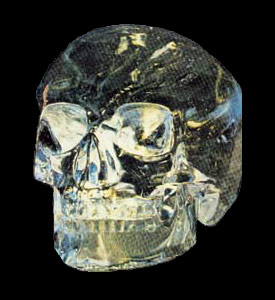
Crystal skulls are not uncommon or terribly mysterious. Thousands are produced every year in Brazil, China, and Germany. But there are a handful of these rather macabre objects that have fueled intense interest and controversy among archaeologists, scientists, spiritualists, and museum officials for more than a century.
There are perhaps a dozen of these rare crystal skulls in private and public collections. Some are crystal clear, others of smoky or colored quartz. Some are actual human size and of very fine detail, while others are smaller and less refined. All are believed to originate from Mexico and Central America.
Many believe these skulls were carved thousands or even tens of thousands of years ago by an ancient Mesoamerican civilization. Others think they may be relics from the legendary island of Atlantis or proof that extraterrestrials visited the Aztec sometime before the Spanish conquest.
Many believe these skulls were carved thousands or even tens of thousands of years ago by an ancient Mesoamerican civilization. Others think they may be relics from the legendary island of Atlantis or proof that extraterrestrials visited the Aztec sometime before the Spanish conquest.
Supernatural Fascination
Stories about the skulls focus heavily on their perceived supernatural powers.
Joshua Shapiro, coauthor of Mysteries of the Crystal Skulls Revealed, on his Web site cites claims of healings and expanded psychic abilities from people who have been in the presence of such skulls.
"We believe the Crystal Skulls are a form of computer which are able to record energy and vibration that occur around them," he writes. " The skull will pictorially replay all events or images of the people who have come into contact with them (i.e. they contain the history of our world)."
Most archaeologists and scientists are skeptical, to say the least.
Skulls were prominent in ancient Mesoamerican artwork, particularly among the Aztec, so the connection between these artifacts and these civilizations is apt.
"[I]t was a symbol of regeneration," says Michael Smith, a professor of anthropology at Arizona State University. "There were several Aztec gods that were represented by skulls, so they were probably invoking these gods. I don't think they were supposed to have specific powers or anything like that."
Stories about the skulls focus heavily on their perceived supernatural powers.
Joshua Shapiro, coauthor of Mysteries of the Crystal Skulls Revealed, on his Web site cites claims of healings and expanded psychic abilities from people who have been in the presence of such skulls.
"We believe the Crystal Skulls are a form of computer which are able to record energy and vibration that occur around them," he writes. " The skull will pictorially replay all events or images of the people who have come into contact with them (i.e. they contain the history of our world)."
Most archaeologists and scientists are skeptical, to say the least.
Skulls were prominent in ancient Mesoamerican artwork, particularly among the Aztec, so the connection between these artifacts and these civilizations is apt.
"[I]t was a symbol of regeneration," says Michael Smith, a professor of anthropology at Arizona State University. "There were several Aztec gods that were represented by skulls, so they were probably invoking these gods. I don't think they were supposed to have specific powers or anything like that."
All Fakes?
In addition, recent electron microscope analyses of skulls by the British Museum and the Smithsonian Institution revealed markings that could only have been made with modern carving implements. Both museums estimate that their skulls date to sometime in the mid- to late 1800s, a time when public interest in ancient cultures was high and museums were eager for pieces to display.
Its examinations and the fact that no such skull has ever been uncovered at an official archaeological excavation led the British Museum to extrapolate that all of the famed crystal skulls are likely fakes.
There is passion on both sides of the issue, and the fact remains that no one knows for sure who made these skulls and when. And since there is currently no way to accurately determine the age of such inorganic objects, the mystery will likely continue. In fact, it's sure to get a boost in 2008 with the release of the action-adventure sequel Indiana Jones and the Kingdom of the Crystal Skull.
In addition, recent electron microscope analyses of skulls by the British Museum and the Smithsonian Institution revealed markings that could only have been made with modern carving implements. Both museums estimate that their skulls date to sometime in the mid- to late 1800s, a time when public interest in ancient cultures was high and museums were eager for pieces to display.
Its examinations and the fact that no such skull has ever been uncovered at an official archaeological excavation led the British Museum to extrapolate that all of the famed crystal skulls are likely fakes.
There is passion on both sides of the issue, and the fact remains that no one knows for sure who made these skulls and when. And since there is currently no way to accurately determine the age of such inorganic objects, the mystery will likely continue. In fact, it's sure to get a boost in 2008 with the release of the action-adventure sequel Indiana Jones and the Kingdom of the Crystal Skull.
Source: National Geographic Picture: Counterfeit crystal skull in the British Museum
Photograph by AFP/Getty Images
Photograph by AFP/Getty Images
Subscribe to:
Comments (Atom)